Phonetic Fluidity in the Agentic Era
A Framework for Evaluating Domain Names for Voice, AI and Conversational Interfaces
A New Dimension of Domain Evaluation
Domain names have traditionally been evaluated through characteristics such as length, keywords, memorability, scarcity, extension, historical use and comparable transactions.
But a domain is no longer encountered only as something that is seen and typed, it can also be spoken, heard, interpreted, remembered and reproduced through increasingly conversational digital environments.
The Phonetic Fluidity Framework examines one specific question:
How easily can a domain name move between its spoken and written forms?
The PFA Framework provides a structured methodology for examining the phonetic and structural characteristics that may influence that relationship.
It does not replace traditional domain evaluation. More importantly, it adds another dimension to it.
Introducing The PFA Framework
What Is Phonetic Fluidity?
Phonetic fluidity describes the relative ease with which a domain name can move between its spoken and written forms without requiring unnecessary clarification, reconstruction or spelling assistance.
A highly fluid name may have a comparatively direct relationship between:
Sound → Recognition → Recall → Reproduction
Conversely, a domain with greater phonetic friction may introduce additional uncertainty between those stages.
This distinction is particularly relevant when the written representation of a domain is not immediately visible.
The central premise of the PFA Framework therefore examines characteristics of a domain that may become more noticeable when the screen is removed.
Why PFA Matters?
The Domain Name Is Entering More Interfaces
The traditional web remains fundamentally important.
- Search engines remain important.
- Websites remain important.
- Visual branding remains important.
However, digital interaction is expanding.
In the modern agentic era in which we now live, a domain may now be:
- Seen.
- Typed.
- Searched.
- Spoken.
- Heard.
- Interpreted.
- Recommended.
- Potentially acted upon by an agent.
The PFA Framework explores whether characteristics that were relatively easy to overlook in a visually dominant environment deserve separate consideration as conversational interaction becomes increasingly important.
With that said, this paper deliberately does not attempt to argue that the traditional web has disappeared or that every AI interaction currently depends upon speech. Instead, it identifies the changing interaction environment that domains now face as the basis and primary reason to examine another characteristic of digital names.
What PFA Examines
A Structured Assessment Of Phonetic And Structural Characteristics
The PFA Framework considers multiple characteristics of a domain name, including:
- Structural composition.
- Phonetic relationships.
- Vowel and consonant patterns.
- Character sequences.
- Linguistic characteristics.
- Domain length.
- Phonetic friction.
- Defined structural patterns.
These characteristics are combined within the PFA methodology to produce a standardised PFA Score and corresponding PFA Tier classification.
The framework is intended to make this particular dimension of domain evaluation observable and comparable.
The Five PFA Classifications
Understanding The PFA Tier System
The PFA Framework classifies assessed domains into five tiers according to their resulting PFA Score.
Tier 1
Ultra-Fluid
The highest PFA Classification, representing domains with exceptionally strong phonetic and structural characteristics within the framework.
Tier 2
High-Authority
Domains exhibiting strong phonetic and structural characteristics with relatively low friction within the PFA model.
Tier 3
Balanced Brandable
Domains presenting a more balanced combination of phonetic characteristics, structural complexity and brandability.
Tier 4
Literal & Long-Tail
Domains where greater length, structure or other characteristics may introduce additional phonetic complexity.
Tier 5
Visual Only
Domains exhibiting substantial phonetic friction within the PFA Framework.
Importantly, a PFA Tier describes the domain within the PFA framework. It does not describe the domain's total commercial, strategic or economic value.
A lower PFA Classification does not necessarily mean that a domain is commercially worthless, just as a high PFA Classification does not automatically make a domain commercially valuable.
PFA Is A Measurement Framework
Not A Prediction Engine
This distinction is fundamental to the PFA Framework.
PFA does not currently represent:
- A probability of successful AI resolution.
- A probability of successful voice-assistant resolution.
- Predicted traffic.
- Predicted conversion.
- Predicted revenue.
- Probability of a domain sale.
- Prediction of market price.
Future research may establish relationships between PFA Scores and measurable real-world outcomes. However, until that research exists, the framework does not make those claims.
PFA And Domain Value
Two Different Questions
A domain's phonetic characteristics are only one part of evaluating a domain.
PFA therefore remains conceptually separate from economic valuation and asks:
How does this domain perform under the PFA phonetic and structural framework?
Valuation asks:
What might this domain be worth economically based on the characteristics and market considerations being assessed?
The market ultimately asks:
What will a willing buyer actually pay?
These questions should not be treated as interchangeable.
A domain can have strong phonetic characteristics and limited market demand.
A domain can also have lower phonetic fluidity while possessing significant strategic, institutional, defensive, historical or category value.
PFA is therefore a dimension of domain assessment, not a universal measure of economic value.
This separation is an important part of the framework's overall design.
PFA Certification
What Does PFA Certification Mean?
PFA Certification identifies that a domain has been assessed under the PFA Framework and assigned a PFA Score and corresponding Tier classification.
The certification communicates the result of the assessment through:
- PFA Score.
- PFA Tier.
- Classification.
- Relevant explanatory characteristics.
It does not guarantee commercial performance and does not constitute a market appraisal.
PFA Certification identifies that an assessment has been completed. It does not certify what a domain is worth.
From Framework To Research
What Still Needs to Be Tested?
The PFA Framework establishes a methodology and a set of hypotheses.
The next question is whether measurable phonetic and structural characteristics correspond to meaningful differences in real-world outcomes.
The framework identifies possible areas for future investigation, including:
Human first-hearing transcription
Can participants correctly reproduce a domain after hearing it once?
Clarification rate
How often does a listener request spelling clarification?
Recall
Can the participant reproduce the domain after a delay?
Speech recognition
How accurately do speech-recognition systems transcribe different domain structures?
Entity resolution
Can systems correctly identify the intended digital entity?
The framework explicitly presents these as questions for empirical investigation rather than established conclusions.
A Framework Designed To Evolve
Research Should Remain Capable of Changing Its Answer
The PFA Framework is not presented as a finished scientific theory.
Its assumptions, classifications and conclusions should remain open to:
- Empirical testing.
- Independent scrutiny.
- Evidence.
- Validation.
- Further refinement.
The purpose of the PFA Research Programme is therefore not simply to support the framework, but to determine where the framework is supported, where it requires modification, and where its assumptions may not withstand testing.
That distinction is vital to the credibility of the work that the programme has carried out this far.
What This Paper Covers
This publication examines:
The Changing Interface
How digital interaction is expanding beyond purely visual interfaces.
Visual to Spoken Recognition
Why hearing a domain creates a different communication problem from seeing it.
Phonetic Fluidity
The working definition and conceptual basis of phonetic fluidity.
Research Basis
Relevant linguistic, naming and processing research.
Phonetic Friction
Characteristics that may introduce additional difficulty between sound and written reproduction.
PFA Methodology
The framework used to assess phonetic and structural characteristics.
PFA Classifications
The five-tier classification system.
Spelling Tax
The communication burden associated with names requiring additional spelling or clarification.
Length and Structure
The relationship between domain structure and phonetic characteristics.
The Agentic Era
Why increasingly conversational interfaces create a reason to examine this dimension.
PFA Certification
What certification represents and what it does not represent.
PFA and Valuation
Why phonetic assessment and economic valuation should remain separate.
Validation, Boundaries and Limitations
How the framework could be tested against real-world human and machine outcomes.
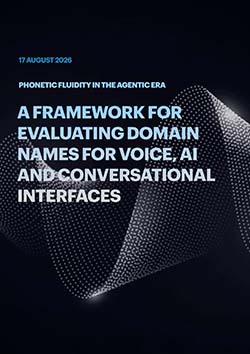
Phonetic Fluidity in the Agentic Era
A Framework for Evaluating Domain Names for Voice, AI and Conversational Interfaces
(2026 Edition)
Document Details
The Phonetic Fluidity Assessment (PFA) Framework, provides a basis for examining multiple characteristics of a domain name, including structural composition, phonetic relationships, vowel and consonant patterns, character sequences, linguistic anchors, domain length and other defined characteristics. The paper details the foundational framework, including its rationale, methodology, classifications, terminology, limitations and proposed areas for future validation.
Length | 54 pages
 Read | Download PDF
Who This Framework Is For?
The publication is intended for:
- Domain owners seeking another way to evaluate the characteristics of their names.
- Domain buyers assessing potential names for businesses, products or brands.
- Brand and naming professionals interested in the relationship between names, speech and digital identity.
- Researchers and linguists interested in the underlying questions surrounding phonetic structure and domain names.
- Technology professionals interested in spoken, conversational and agent-mediated interfaces.
- Domain industry professionals interested in emerging approaches to domain assessment.
What You'll Find In Our Research
Research into the strategic, commercial and branding value of premium domain names.
How businesses can access premium domains through structured leasing arrangements.
Domain Investment
Ideas and analysis relating to acquiring, holding and managing domain assets.
Domain Valuation
Understanding the factors that influence premium domain value and commercial potential.
Web3 & Digital Assets
Exploring domains, decentralised identity and the changing digital asset landscape.
Branding & Digital Identity
How domain names influence brand positioning, trust, memorability and digital identity.
Why We Publish
The domain industry is constantly changing.
Premium domains are increasingly being considered not simply as web addresses, but as strategic digital assets that can influence brand identity, customer trust, marketing performance and long-term commercial positioning.
We believe better decisions begin with better information.
domainAlot publishes research to contribute practical knowledge and thoughtful analysis to the premium domain industry, helping domain owners, investors and businesses make more informed decisions about acquiring, using, leasing and managing premium domains.
About domainAlot Research
domainAlot is a premium domain marketplace specialising in the sale and leasing of valuable domain names. Our research examines the commercial and strategic role of domains in modern businesses, with a particular focus on premium digital assets.
Explore Our Research
Phonetic Fluidity Assessment (PFA)
Premium Domains
Branding & Digital Identity