The Definitive Guide to Domain Leasing
Understanding the Future of Premium Digital Assets
Understanding Domain Leasing
Premium domain names have traditionally been viewed primarily as assets to purchase, but ownership is not the only way a business can obtain access to a valuable domain.
Domain leasing provides an alternative model in which a business can use a premium domain for an agreed period while ownership remains with the domain owner.
This creates an important distinction between owning a digital asset and accessing its commercial utility.
For some businesses, outright acquisition may be the appropriate solution. For others, leasing can provide access to a domain that might otherwise require a substantially larger upfront investment.
This guide examines domain leasing from both sides of the transaction, exploring key aspects of:
- How domain leasing works?
- Why more and more businesses choose to lease premium domains?
- How terms, pricing and agreements can be structured?
- How leasing compares with purchasing and lease-to-own arrangements?
- What the emerging Premium Domain Access Economy may mean for the future of premium digital assets?
Why Ownership and Access Are Not the Same Thing
A premium domain can provide value in two fundamentally different ways.
Ownership: provides control of the underlying digital asset.
Access: provides the ability to use that asset without necessarily acquiring ownership immediately.
Domain leasing sits between those concepts, meaning the important question is no longer simply:
"Can we afford to buy this domain?"
But now becomes:
"What is the value of having access to this domain, and is leasing an appropriate way to obtain that access?"
The Premium Domain Access Economy
The domain market has historically been structured around ownership:
- A domain is registered.
- It is held by an owner.
- Another party may eventually purchase it.
- The domain is transferred to the new owner.
Leasing introduces an all together different relationship.
Through leasing, the economic value of the domain can be separated into two related concepts:
The value of ownership.
And
The value of access.
A business may not need, nor require permanent ownership on day one to obtain meaningful commercial use from a premium domain.
Such demand creates an access-oriented model in which businesses can potentially use premium digital assets while managing capital requirements, testing a brand, launching a product or pursuing a defined business period.
This does not make ownership less valuable. Rather, it creates an entirely different way of thinking about how digital assets can be used.
That is the core idea behind the Premium Domain Access Economy.
Why Would a Business Lease a Premium Domain?
A business might consider leasing when it wants access to a premium domain but does not want, or cannot justify, an immediate outright acquisition. In such instances, potential considerations might include:
Capital management
Leasing may reduce the amount of capital required upfront.
Brand development
A business may want to establish a brand on a premium domain without immediately committing to permanent ownership.
Market testing
A company may want to evaluate a brand or business concept before making a larger long-term commitment.
Product launches
A premium domain may be useful for a specific product, campaign or defined business initiative.
Access to scarce assets
Some domains may be available to use through leasing even when outright acquisition would require substantially more capital.
Understanding Domain Lease Pricing
There is no universal formula that determines the correct lease price for every domain.
Lease pricing can be influenced by factors such as:
- The domain itself.
- Its characteristics.
- Extension.
- Scarcity.
- Commercial relevance.
- Seller expectations.
- Lease duration.
- Payment structure.
- Exclusivity.
- Market conditions.
The annual lease price cannot therefore be automatically interpreted as a percentage of an objectively established domain value.
Different owners and marketplaces may structure leasing differently, meaning the buyer should evaluate the total cost of the lease against the expected usefulness of the domain and available alternatives.
What Should a Domain Lease Agreement Address?
A serious domain lease should clearly establish matters such as:
Parties
Who owns the domain and who is receiving the right to use it?
Term
How long does the agreement last?
Payment
How much is due, when is it due and what happens after missed payments?
Use
What may the domain be used for?
Renewal
Can the lease be renewed, and on what terms?
Termination
Under what circumstances can either party terminate?
Transfer
Can the domain be transferred during the lease?
Control
Who controls DNS, registrar access and related technical functions?
Purchase option
Does the lessee have an option to purchase the domain?
Default
What happens if either party fails to meet its obligations?
The exact terms will vary between agreements, and significant transactions may justify professional legal review.
What This Guide Covers
In this guide you'll learn:
The Changing Premium Domain Market
Why domain ownership and domain access are increasingly worth considering separately.
What Is Domain Leasing?
How leasing differs from purchasing and what the basic relationship involves.
The Premium Domain Access Economy
The distinction between ownership and access.
Why Businesses Lease
Capital management, branding, launches, testing and other potential use cases.
Leasing vs Buying
The practical and economic differences between the two approaches.
Leasing vs Lease-to-Own
How temporary access differs from arrangements designed to lead toward ownership.
How Leasing Works
The typical lifecycle of a premium domain lease.
Pricing
How lease pricing can be considered and what factors may influence it.
Agreements
The issues both parties should understand before entering a lease.
Mistakes and Best Practices
Common problems and practical considerations.
The Future of Domain Leasing
How changing digital-business models may affect the market.
Operating Model
How domain owners and businesses can approach leasing as an ongoing process.
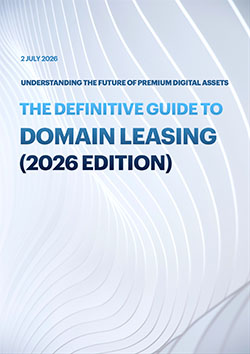
The Definitive Guide to Domain Leasing
Understanding the Future of Premium Digital Assets
(2026 Edition)
Document Details
Domain leasing is emerging as an alternative way for businesses to access premium digital assets without acquiring ownership outright. The Definitive Guide to Domain Leasing examines the economics, strategy and practical operation of premium domain leasing, from selecting the right domain and negotiating commercial terms through pricing, agreements, technical deployment, renewal and long-term business considerations.
Length | 88 pages
 Read | Download PDF
Who Is This Guide For?
This guide is intended for:
- Businesses and founders considering a premium domain for a new or existing venture.
- Brand and marketing professionals evaluating domain acquisition strategies.
- Domain owners considering leasing as an alternative to an outright sale.
- Domain investors interested in recurring revenue models and alternative asset structures.
- Businesses considering lease-to-own arrangements as an alternative path toward ownership.
- Anyone seeking to understand the economics and mechanics of premium domain leasing.
What You'll Find In Our Research
Phonetic Fluidity Assessment (PFA)
Research into the relationship between spoken and written representations of domain names.
Research into the strategic, commercial and branding value of premium domain names.
Domain Investment
Ideas and analysis relating to acquiring, holding and managing domain assets.
Domain Valuation
Understanding the factors that influence premium domain value and commercial potential.
Web3 & Digital Assets
Exploring domains, decentralised identity and the changing digital asset landscape.
Branding & Digital Identity
How domain names influence brand positioning, trust, memorability and digital identity.
Why We Publish
The domain industry is constantly changing.
Premium domains are increasingly being considered not simply as web addresses, but as strategic digital assets that can influence brand identity, customer trust, marketing performance and long-term commercial positioning.
We believe better decisions begin with better information.
domainAlot publishes research to contribute practical knowledge and thoughtful analysis to the premium domain industry, helping domain owners, investors and businesses make more informed decisions about acquiring, using, leasing and managing premium domains.
About domainAlot Research
domainAlot is a premium domain marketplace specialising in the sale and leasing of valuable domain names. Our research examines the commercial and strategic role of domains in modern businesses, with a particular focus on premium digital assets.