PFA Research & Methodology
Research, evidence and ongoing validation of the Phonetic Fluidity Audit
Open Research Based Upon an Independent Methodology
The role of the domain name has changed substantially alongside the development of the commercial internet.
What began primarily as an address associated with an online presence has evolved into a persistent digital identifier supporting discovery, communication, commerce, customer service and many other aspects of modern digital activity.
As digital interaction continues to evolve, domains are increasingly encountered not only as written text, but through speech, voice interfaces, natural-language systems and conversational AI. These newer forms of interaction not only pose challenges for resolving domain names correctly, but raise a broader question in addition.
Opening Principle
"If the role of the domain has changed, then the characteristics by which we evaluate a domain may also need to evolve."
This principle provides the foundation for the PFA Research Programme.
The Phonetic Fluidity Audit (PFA) proposes that phonetic and structural characteristics represent an additional dimension of domain assessment that warrants structured examination as digital interaction becomes increasingly conversational.
The Evolution of the Domain
In the early commercial years of the web, an organisation's domain typically functioned as an address for a basic, and often limited online presence. A website might provide corporate information, publish basic content or support an existing marketing campaign, while many of the organisation's principal interactions with customers continued to take place through established offline channels. However, as internet adoption expanded, this relationship changed.
Websites evolved from relatively simple information resources into increasingly important platforms for publishing, discovery, communication, commerce, customer service and business operations.
Search engines changed how people discovered organisations, e-commerce changed how transactions were conducted, and digital communication became integrated into everyday commercial activity. As a result, the domain consequently acquired a broader role.
Rather than simply pointing toward a website, a domain could become a persistent digital identifier for an organisation, product, service or community. It could appear across advertising, search results, email, social media, packaging, documentation and customer communications. It could provide the destination through which customers discover information, make purchases, access services, request support or establish an ongoing relationship with an organisation.
Today, the significance of the domain extends far beyond its technical function as an internet address.
For many organisations, the domain has become an important component of digital identity and a persistent reference point connecting multiple aspects of the business.
This evolution matters when considering how domains should be evaluated, and a characteristic that may have been relatively inconsequential when a domain was primarily an address attached to a corporate website can become more relevant when that same domain is repeatedly used as an organisation's public identity.
From Being Seen to Being Spoken
For much of the history of the web, the domain was predominantly encountered visually.
A user could see the written form of a domain in an advertisement, search result, printed material, website or browser address bar.
The emergence and expansion of voice interfaces, speech recognition, conversational systems and AI-mediated interaction, introduce another way in which a domain may be encountered.
In the modern agentic era, a user may hear a domain before seeing its written form, meaning that instead of:
Seen → Read → Recognised
The communication pathway can become:
Heard → Interpreted → Remembered → Reproduced
This introduces an entirely different set of considerations.
When a domain is displayed visually, unusual spelling, ambiguous characters or structural complexity can often be examined directly by the user. However, when the same domain is spoken, the listener must reconstruct its written representation from sound alone.
A listener may therefore need to determine whether a sound corresponds to one spelling or another, whether a character is present, whether a word contains a particular consonant combination, whether a hyphen or numerical substitution is involved, or whether an unfamiliar construction has been heard correctly.
These considerations do not make visual characteristics irrelevant. Nor do they mean that every domain needs to be optimised for spoken communication. What they do is establish a question requiring greater consideration than previously observed:
How does a domain behave when its written representation is unavailable?
This question becomes increasingly relevant as interaction with digital systems continue to expand beyond interfaces in which information is primarily displayed on a screen, and the basis for a structured framework needed in order to examine this dimension.
A New Dimension of Domain Evaluation
The evolution of the domain has therefore created a corresponding question about domain evaluation:
If domains now operate across visual, written, spoken and conversational environments, should evaluation consider characteristics relevant to each of those environments?
PFA focuses on one specific dimension in the evaluation process:
The phonetic and structural relationship between how a domain is spoken and how it is represented in writing.
It does not seek to replace other approaches to domain evaluation, but to make this particular dimension measurable.
The Phonetic Fluidity Audit (PFA)
The Phonetic Fluidity Audit (PFA) is an evolving methodology for evaluating the phonetic and structural characteristics of domain names.
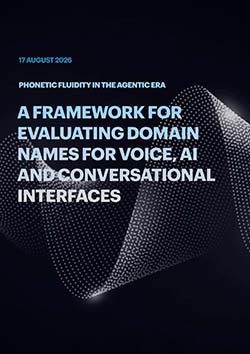
Its application is a framework for evaluating domain names for voice, AI and conversational interfaces.
The PFA Research Programme exists to examine the evidence behind the methodology, document its development, investigate its underlying hypotheses and encourage independent scrutiny and validation.
PFA is not presented as a finished scientific theory. It is a structured framework that can be tested, challenged and refined as evidence develops. For these reasons, the PFA Framework is an open programme of research, validation and continuous improvement.
Featured Research Paper
The PFA Framework
Learn more about phonetic fluidity in the agentic era and discover the research behind the PFA framework.
Document Details
A domain may be visually distinctive yet difficult to reproduce accurately when heard. Conversely, another domain may have a comparatively direct relationship between its spoken and written forms. This paper introduces Phonetic Fluidity, a framework for considering that distinction, and presents the Phonetic Fluidity Audit (PFA) as a structured methodology developed by domainAlot to evaluate it.
Length | 54 pages
 Read | Download PDF