PFA Research Papers
Research Into Phonetic Fluidity, Domain Names And The PFA Framework
Research Should Examine the Question Before Assuming the Answer
The PFA Research Papers form the substantive research record of the Phonetic Fluidity Audit (PFA) Research Programme.
They examine the ideas, assumptions, evidence and hypotheses underlying PFA, as well as questions that may challenge or refine the framework.
A research paper does not exist to prove that PFA is correct, it exists to investigate a question.
That distinction is fundamental to the PFA Research Programme.
Why Publish Research Papers?
The Phonetic Fluidity Audit was developed from an observation that domain names increasingly exist across more than one communication environment.
A domain can be seen, read and typed, but it can also be spoken, heard and communicated through voice and conversational interfaces.
The PFA Research Programme asks whether characteristics associated with phonetic and structural form deserve greater consideration when evaluating domains in these environments.
That question cannot be answered simply by presenting a scoring system. It requires examination of the evidence surrounding the underlying concepts, and PFA Research Papers provide the mechanism for doing that.
They allow individual questions to be investigated independently, evidence to be documented, hypotheses to be tested and conclusions to be reconsidered as knowledge develops.
What Constitutes A PFA Research Paper?
A PFA Research Paper is a documented investigation into a specific question relevant to phonetic fluidity, domain names, spoken communication, language processing, speech technology or the PFA Framework.
Depending upon the subject, a paper may:
- Examine existing academic or technical research.
- Investigate a specific PFA hypothesis.
- Analyse linguistic or phonetic characteristics.
- Examine speech-recognition considerations.
- Investigate human perception or processing.
- Compare alternative approaches.
- Examine the relationship between spoken and written representations.
- Test elements of the PFA methodology.
- Identify limitations or potential weaknesses.
- Investigate contradictory evidence.
- Propose areas for further research.
- Report empirical testing conducted as part of the programme.
Not every paper will reach the same type of conclusion.
> Some may provide supporting evidence.
> Some may identify weaknesses.
> Some may produce inconclusive results.
> Some may raise questions that require substantially more investigation.
That is an intended part of the research process.
Published Research
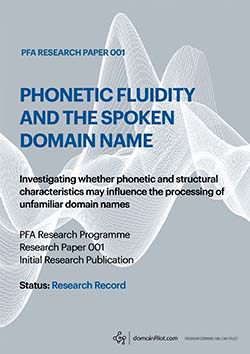
PFA Research Paper 001
Phonetic Fluidity and the Spoken Domain Name
Investigating whether phonetic and structural characteristics may influence the processing of unfamiliar domain names.
Status: Published
Research Paper: 001
PFA Framework Version: 1.0
PFA Research Paper 001 is the first formal publication in the PFA Research Programme.
Document Details
The paper examines research concerning phonological structure, pronunciation fluency, unfamiliar names, sound-to-spelling conversion, brand-name processing and automatic speech recognition. Its purpose is to investigate whether existing evidence provides a reasonable foundation for examining the spoken characteristics of domain names, while clearly distinguishing that evidence from validation of the PFA Framework itself.
Length | 31 pages

Research Questions Always Come First
The PFA Research Programme does not begin with the assumption that every proposition associated with PFA is correct.
Instead, research begins with questions.
For example:
Does phonetic structure affect how easily unfamiliar names are reproduced after being heard?
Do certain consonant combinations create measurable pronunciation or recognition difficulty?
How does speech-recognition technology handle rare or unfamiliar domain-like names?
Does pronunciation fluency influence recognition or recall of artificial brand names?
Are characteristics identified by the PFA Framework supported by evidence across different languages and linguistic environments?
Can the PFA scoring model itself demonstrate consistent relationships with measurable outcomes?
Question such as these are different from asking whether PFA is in itself useful. They investigate the individual propositions on which usefulness would ultimately depend.
Evidence Before Conclusion
Where relevant, research papers will distinguish between several different levels of interpretation.
Established Evidence
Findings supported by credible external research or appropriately conducted testing.
Observation
A result or pattern identified during an investigation that may warrant further examination.
Interpretation
An explanation of what an observation or finding may mean.
Hypothesis
A proposition that can be tested but has not yet been established.
Research Question
An unresolved question requiring further investigation.
Conclusion
The interpretation reached from the evidence examined within the particular paper.
These categories should not be treated as interchangeable because:
- A plausible hypothesis is not established evidence.
- A correlation is not automatically causation.
- A result from one experiment does not necessarily establish a universal rule.
- An observation about human language does not automatically establish how an AI system will behave.
The distinction between these categories is therefore an important part of the PFA Research Standard.
What Research Papers May Examine
The PFA Research Programme is deliberately broader than the PFA scoring algorithm itself.
Potential research areas include, but are by no means limited to:
Phonetic Structure
The relationship between vowels, consonants, syllable structure, consonant sequences and other characteristics of spoken names.
Pronunciation and Fluency
Research into the ease or difficulty with which names can be pronounced, repeated and processed.
Human Recognition and Memory
Research concerning recognition, recall, familiarity, processing effort and the relationship between name characteristics and human responses.
Speech Recognition
Research into automatic speech recognition, pronunciation variation, rare words, unfamiliar names and named entities.
Spoken-to-Written Resolution
Investigation into the challenges involved in reconstructing a written representation from a spoken name.
Linguistic Variation
Research examining whether phonetic characteristics behave consistently across languages, accents, dialects and linguistic backgrounds.
Domain Names as Digital Identifiers
Investigation into how the changing role of the domain may create new considerations for domain assessment.
PFA Model Testing
Research examining whether the characteristics, scoring structure or classifications used by PFA correspond with measurable outcomes.
Alternative Explanations
Research that examines whether apparent PFA effects may instead be explained by other factors such as familiarity, semantics, language, context, domain extension, brand recognition or existing exposure.
Limitations and Failure Cases
Research examining domains or situations where the assumptions underlying PFA may not apply.
This final category is particularly important because a methodology should not only investigate where it appears to work, but should also investigate where it does not.
Research Papers And The PFA Methodology
The PFA Research Papers archive and the PFA Methodology serve different purposes.
The Methodology describes the current PFA Framework.
The Research Papers investigate questions relating to that framework.
The Evidence & Sources section documents relevant external evidence.
The Validation section examines whether the framework itself withstands structured testing.
The Versions section records the documented state of the methodology.
The Change Log records substantive changes and the reasons behind them.
This separation allows the research programme to maintain a distinction between:
What PFA currently does?
And
What research has established about whether it should do it?
That distinction should remain intact as the PFA Research Programme continues to develop.
Research Does Not Automatically Change PFA
A research finding does not automatically result in an update or methodology change.
Before research should influence the PFA Framework, its relevance, quality, reproducibility and relationship to the methodology must be considered.
Where appropriate, findings may lead to:
- No Change.
- Further investigation.
- A documented limitation.
- Refinement of an existing component.
- Modification of a scoring characteristic.
- Revision of a classification.
- A methodological change.
- A new research question.
Where a substantive methodological change is ultimately made, it should be reflected through the PFA Versioning and PFA Change-Log system.
This creates and allows for a clearly traceable relationship between research and methodology.
Research Should Be Capable Of Challenging PFA
The purpose of a research programme is not to accumulate evidence that confirms an existing belief.
Evidence that challenges PFA may be as valuable as evidence that supports it.
For example:
- A result showing that a proposed characteristic has little measurable effect may indicate that the characteristic should receive less importance.
- A finding that applies only in particular linguistic environments may require the scope of a proposition to be narrowed.
- A failed experiment may identify a weakness in an assumption.
- An alternative explanation may reveal that an apparent PFA effect is actually attributable to another variable.
These outcomes are not failures of the research programme. They are information.
The objective of the PFA Research Programme is not to protect the framework from criticism, but to determine how well the framework survives it.
Research Paper Standards
Research papers published within the programme should, where applicable, provide sufficient information for the reader to understand:
Research question
What specific question is being investigated?
Background
Why does the question matter?
Existing evidence
What relevant research already exists?
Method
How was the question investigated?
Results
What was observed or found?
Interpretation
What might those findings mean?
Limitations
What prevents the findings from being treated as more conclusive?
Conclusion
What can reasonably be concluded from the evidence examined?
Further research
What remains unresolved?
Sources
What evidence supports the research?
Not every paper will require every component in exactly the same form.
The structure may vary according to the nature of the investigation. However, the underlying principle will remain the same:
The reader should be able to distinguish the difference between what was observed from what was inferred.
Research Paper Numbering
PFA Research Papers will be assigned sequential identifiers.
For example:
PFA Research Paper 001
PFA Research Paper 002
PFA Research Paper 003
Numbering provides a permanent reference to each paper and allows the research record to develop over time.
A paper will retain its identifier even if later research challenges, qualifies or supersedes one or more of its findings.
Where a paper is materially revised, the revision should be documented rather than silently replacing the historical record.
Research, Review And Independence
The PFA Research Programme is developed by domainAlot, and PFA itself is a methodology developed by domainAlot.
This relationship should be understood when interpreting the research.
The programme therefore encourages external scrutiny, independent contributions and constructive challenge.
Where appropriate, research may incorporate:
- Academic literature.
- Technical research.
- Empirical testing.
- Independent analysis.
- Contributed evidence.
- Comparative studies.
- Replication attempts.
- Alternative interpretations.
- Independent review.
The objective is not to create an appearance of independence where none exists. It is to create a process through which the methodology can be examined by evidence and challenged by reason.
What The Research Programme Does Not Claim
The existence of a research paper does not mean that PFA has been scientifically validated.
Individual research findings should not automatically be interpreted as evidence that:
- A particular PFA Score predicts commercial success.
- A PFA Tier determines domain value.
- A domain will be correctly resolved by every voice assistant.
- AI systems will interpret a domain in a particular way.
- Phonetic characteristics determine traffic or conversion.
- PFA replaces established domain valuation methods.
Such statements are substantially stronger propositions than existing PFA Methodology is able to support and would require evidence appropriate to each claim.
PFA remains one dimension of domain assessment.
Its broader propositions remain subject to investigation.
An Evolving Research Record
The first research paper is not intended to represent the final position of the PFA Research Programme.
As new evidence becomes available, earlier conclusions may be refined.
Research may reveal limitations that require the PFA Methodology to change.
Future papers may contradict assumptions made in earlier papers.
New technologies may introduce questions that could not previously have been investigated.
This is why the programme maintains evidence records, validation research, methodology versions and a change log alongside the research papers themselves.
The objective of an evolving research record is not to create a static body of claims, but a documented record of inquiry.
The Research Principle
A methodology becomes more useful when the questions surrounding it are made explicit, and becomes more credible when those questions are examined.
Therefore, a methodology becomes more valuable as a research framework when it remains capable of changing in response to what the evidence shows.
Research should not ask how to prove the methodology. It should ask whether the methodology survives examination.
Current Research
PFA Research Paper 001
Phonetic Fluidity and the Spoken Domain Name
The first paper in the series examines the underlying proposition that the phonetic and structural characteristics of a domain name may influence how easily the name can be spoken, heard, recognised, remembered or reproduced.
The paper examines relevant research in phonetics, language processing, brand-name fluency and speech technology before considering what that evidence can, and cannot, tell us about the assumptions underlying PFA.
Status: Research in development.
Explore The PFA Research Programme
> About PFA
Understand the origins and purpose of the Phonetic Fluidity Audit.
> PFA Principles
Explore the principles that guide the research programme.
> PFA Methodology
Understand what the current PFA Framework evaluates.
> Evidence & Sources
Explore the external research and evidence informing the programme.
> PFA Validation
Examine how the methodology itself is tested.
> PFA Versions
Track the documented evolution of the framework.
> PFA Change Log
See what has changed and why.
> PFA Certification
Understand what PFA Certification represents.
> Contact The PFA Research Programme
Contribute evidence, propose collaboration, question the methodology or make a research enquiry.