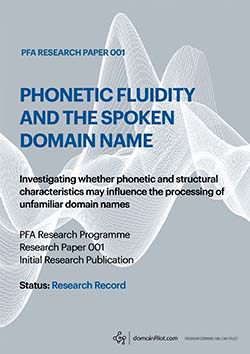
PFA Research Paper 001
Phonetic Fluidity And The Spoken Domain Name
Investigating whether phonetic and structural characteristics may influence the processing of unfamiliar domain names
PFA Research Programme
Research Paper 001
Initial Research Publication
Status: Published
About This Research Paper
PFA Research Paper 001 is the first formal research paper published within the PFA Research Programme.
The paper examines a foundational question underlying the Phonetic Fluidity Audit:
To what extent does the phonetic and structural character of a domain name affect the ease with which the name can be spoken, heard, recognised, remembered or reproduced?
The question arises from a changing digital communication environment in which domain names may increasingly be encountered not only as written identifiers, but also through voice interfaces, conversational systems, speech recognition and other spoken interactions.
The purpose of this paper is not to establish that the PFA Framework is correct, it is to examine whether existing evidence provides a reasonable foundation for investigating the underlying phenomenon.
Abstract
Domain names have traditionally been evaluated primarily as written identifiers.
The increasing use of voice interfaces, conversational systems and speech-based interaction introduces another environment in which a domain name may be encountered: the spoken environment.
This paper reviews relevant research concerning phonological structure, phonotactic probability, pronunciation fluency, unfamiliar names, novel brand names, auditory-to-written conversion and automatic speech recognition.
The evidence provides reasonable support for the broader proposition that characteristics of linguistic form can influence aspects of human processing and that unfamiliar or rare names can present challenges for speech-recognition systems.
However, the evidence does not establish that the specific characteristics, weighting, scoring system or Tier classifications used by PFA predict those outcomes for domain names.
The findings therefore support further investigation of the underlying phenomenon, but do not constitute validation of the PFA Framework itself.
The Central Research Question
The paper investigates:
To what extent does the phonetic and structural character of a domain name affect the ease with which the name can be spoken, heard, recognised, remembered or reproduced?
The investigation is divided into five supporting questions.
Pronunciation
Do particular phonetic structures make unfamiliar names more difficult to pronounce or repeat?
Perception and Recognition
Can phonological characteristics influence how readily unfamiliar spoken forms are processed or recognised?
Memory
Can pronunciation, phonological structure or related linguistic characteristics influence retention or recall?
Speech Recognition
Do rare, unfamiliar or structurally unusual names create measurable challenges for automatic speech-recognition systems?
Generalisability
Can findings concerning phonetic or linguistic processing reasonably be generalised across languages, accents, dialects and communication environments?
Why The Querstion Matters
A domain name encountered visually can be copied directly from what the user sees.
However, a domain encountered through speech presents a different sequence of tasks.
The listener may need to hear the name, interpret its sounds, reproduce the pronunciation, remember it and reconstruct its written representation.
The same domain name may therefore behave differently depending upon how it is encountered.
This does not mean that spoken characteristics are necessarily more important than traditional domain characteristics, it means that they represent a potentially distinct dimension of domain assessment that warrants investigation.
The paper therefore examines the underlying question without assuming the answer.
What The Paper Examines
The research considers evidence from several related fields.
Phonological Structure
Research concerning sound sequences, phonotactic probability and the relationship between phonological structure and language processing.
Unfamiliar Names
Research concerning pronunciation, familiarity and processing of names that may not have established lexical familiarity.
Brand Names and Novel Words
Research concerning invented or non-dictionary names and the relationship between phonological characteristics, fluency, memory and perception.
Sound-to-Spelling Conversion
Research concerning what happens when an unfamiliar spoken name must subsequently be represented in written form.
Speech Recognition
Research concerning the recognition of rare, unfamiliar or previously unseen names and named entities by automatic speech-recognition systems.
Linguistic Variation
Research concerning the influence of language, dialect, accent and other linguistic factors on phonological processing.
What The Evidence Suggests
The evidence reviewed in Paper 001 supports several limited propositions:
- Phonological characteristics can influence aspects of human language processing.
- Pronunciation and linguistic fluency can influence how unfamiliar names are processed or evaluated.
- Unfamiliar spoken names can create sound-to-spelling challenges.
- Rare or unfamiliar entities can present challenges for automatic speech-recognition systems.
These findings provide a reasonable basis for investigating whether the spoken characteristics of domain names deserve consideration in a changing digital communication environment. They do not, however, establish the PFA Framework itself.
What Remains Unestablished
The paper does not establish that:
- PFA Scores predict speech-recognition accuracy.
- PFA Tiers correspond to objectively different levels of spoken performance.
- The specific PFA Scoring weights are empirically optimal.
- PFA predicts commercial success.
- PFA predicts domain value.
- A lower PFA Score necessarily means greater difficulty for every human or AI listener.
- Phonetic characteristics have a fixed monetary cost.
These remain questions for future research and validation.
An Important Finding
One of the principal findings emerging from the review is that "Phonetic Fluidity" may not represent a single naturally occurring variable.
The concept used by PFA potentially encompasses several related but distinct characteristics, including:
- Phonological structure.
- Phonotactic probability.
- Pronunciation ease.
- Processing fluency.
- Familiarity.
- Sound-to-spelling consistency.
- Speech-recognition performance.
These concepts should not automatically be treated as interchangeable.
Further research is therefore required to determine whether phonetic fluidity can be operationalised as a meaningful construct, or whether it is better understood as a composite framework incorporating several measurable characteristics.
Human Processing Versus Machine Processing
Paper 001 also identifies an important distinction between human language processing and automatic speech recognition.
Evidence that a name is difficult for a human listener does not automatically establish that the same name is difficult for an ASR system.
Likewise, evidence that an ASR system struggles with a rare entity does not establish that human listeners will experience the same difficulty.
Human listeners and speech-recognition systems use different mechanisms and can respond differently to context, familiarity, pronunciation and linguistic structure.
The PFA Research Programme should therefore treat human and machine processing as related but distinct research environments.
The Spelling Tax Question
Paper 001 also revisits the concept sometimes described within PFA as a "Spelling Tax."
The research provides a basis for recognising that a spoken name may create additional effort when the listener must infer its written representation, particularly where multiple spellings may be compatible with the heard form.
However, the evidence does not establish a universal numerical or financial cost.
The more defensible interpretation is that some spoken names may impose greater communication effort when their auditory representation does not provide a sufficiently clear route to their intended written representation.
Any monetary interpretation would require separate empirical evidence.
Implications For PFA
Validation of the current PFA Algorithm requires substantive analysis and research does not attempt to validate the algorithm at this time.
Instead, it identifies several areas requiring further examination, including:
Construct definition
What precisely should Phonetic Fluidity represent?
Feature validation
Which measurable characteristics of a domain name actually influence spoken performance?.
Weighting validation
Are the relative weights assigned to different characteristics empirically defensible?
Human testing
Do independently measured PFA characteristics correspond with measurable pronunciation, recognition, recall or reproduction outcomes?
Speech-recognition testing
Does PFA correspond with actual performance across speech-recognition systems?
Cross-linguistic testing
How do language, accent and dialect affect the relationship between domain structure and spoken performance?
Comparative testing
Does PFA provide information beyond simpler linguistic measures?
These are research priorities, not established conclusions.
Conclusion
The evidence reviewed in Paper 001 supports a limited but important conclusion.
There is credible research demonstrating that phonological structure, phonotactic characteristics, pronunciation fluency, familiarity and sound-to-spelling relationships can influence aspects of human processing.
There is also evidence that unfamiliar and rare linguistic entities can present challenges for automatic speech-recognition systems, while contextual information can alter recognition performance.
These findings provide a legitimate basis for investigating whether the spoken characteristics of domain names deserve consideration in a changing digital communication environment.
However, the evidence does not establish that the specific characteristics, scoring weights or Tier classifications used by PFA predict those outcomes for domain names.
The appropriate research position is therefore:
The underlying phenomenon motivating PFA is sufficiently supported by existing research to justify systematic investigation, but the PFA Framework itself remains an unvalidated research hypothesis requiring empirical testing.
That distinction defines the current boundary of the evidence.
Limitations
Paper 001 has several important limitations.
The literature reviewed concerns related linguistic, psycholinguistic, branding and speech-recognition phenomena rather than domain names specifically.
The studies examine different outcomes, including pronunciation, recognition, memory, preference and speech-recognition accuracy. These outcomes are not equivalent.
The evidence also comes from different languages, populations, tasks and experimental conditions.
Many studies use controlled experimental stimuli rather than naturally occurring domain names.
Most importantly, the research reviewed does not directly test the current PFA Scoring Algorithm.
The conclusions should therefore be understood as establishing a basis for further investigation rather than validating PFA.
Questions For Future Research
Paper 001 identifies a number of questions that may be examined by subsequent research.
Can phonetic fluidity be operationalised using established linguistic and psycholinguistic measures?
Which measurable characteristics of a domain name most strongly influence human pronunciation and recognition?
Does PFA predict human performance better than simpler linguistic measures?
Does PFA predict speech-recognition performance?
Do different speech-recognition systems produce different results for the same domain names?
How much does contextual information reduce recognition difficulty?
How do language, accent and dialect affect spoken-domain performance?
Are the current PFA scoring weights empirically defensible?
Do the current PFA Tier boundaries correspond to measurable differences in performance?
Does PFA provide information beyond established linguistic measures?
These questions form part of the continuing PFA Research Programme.
Research Status
Paper: PFA Research Paper 001
Title: Phonetic Fluidity and the Spoken Domain Name
Programme: PFA Research Programme
Status: Published
Research position: Initial research publication
Methodology version: PFA Framework Version 1.0
Paper 001 represents the initial research position of the PFA Research Programme on the relationship between phonetic characteristics and spoken domain names.
Future research may strengthen, qualify, challenge or replace conclusions presented in this paper.
Where subsequent research materially changes the position established here, that development should be documented within the PFA Research Programme.
Download The Research Paper
The complete research paper is available as a formal PDF publication.
The PDF represents the formal publication record of Paper 001.
Document Details
PFA Research Paper 001
Phonetic Fluidity and the Spoken Domain Name
Length | 31 pages
 Read | Download PDF
How Paper 001 Relates To The PFA Research Programme
Paper 001 should be read as part of the wider PFA Research Programme.
Evidence & Sources
Documents the research and evidence informing the programme.
PFA Validation
Examines how the PFA Framework itself can be tested.
Independent Review
Provides a mechanism for external examination of research and methodology.
PFA Versions
Records the documented state and evolution of the framework.
PFA Change Log
Records substantive methodological changes and the reasons behind them.
Contribute to Research
Provides a route for external evidence, expertise, criticism and collaboration.
Research Principle
The purpose of Paper 001 is not to prove that PFA is correct.
It is to establish what the existing evidence allows us to say, identify what remains uncertain, and define the questions that must be answered before stronger conclusions can responsibly be drawn.
Research should remain capable of changing its answer.
Explore The PFA Research Programme
> Research Papers
Return to the complete PFA Research Papers archive.
> Evidence & Sources
Explore the evidence informing the PFA Research Programme.
> PFA Validation
Examine how the PFA Framework is tested.
> Independent Review
Understand how external scrutiny can examine PFA research and methodology.
> Contribute to Research
Contribute evidence, expertise, criticism or collaboration.
> Research Contact
Contact The PFA Research Programme.